
Enterprise AI, built to run
We build and govern production AI.
CMW AI Labs engineers enterprise AI systems built for production — retrieval platforms, voice agents, autonomous AI workflows, and the governance infrastructure around them.
Our focus is not just making AI work, but making it reliable, secure, observable, and accountable at scale.
Who we build for
Case study: WorldatWork →






What we work on
Enterprise RAG
Retrieval-augmented generation in production: architecture, accuracy, security, and what it actually costs to build an enterprise assistant.
AI for Associations
How associations put AI to work across member knowledge, intelligence, learning, community, non-dues revenue, and governance.
Mobile Apps for Associations
Building member and event apps: platform choices, budgets, and where AI genuinely earns its place in the experience.
Voice AI
Voice agents that hold up on a real phone call — latency budgets, the build-versus-buy decision, and member support at scale.
Enterprise AI Governance
Governance as engineering: NIST AI RMF, the EU AI Act, tooling, and governing coding agents inside the enterprise.
AI Agents
Agentic systems in the enterprise: the Model Context Protocol, single- versus multi-agent design, and what ships reliably.
Adding AI to Existing Products
Putting AI inside software that already has customers: which workflow to start from, how to integrate it, and what it takes to make the feature worth paying for.
Evals and LLMOps
How to tell whether an AI feature actually works: reading real failures, building test sets from production, validating the judge that grades them, and keeping the measurement running after launch.
What we build
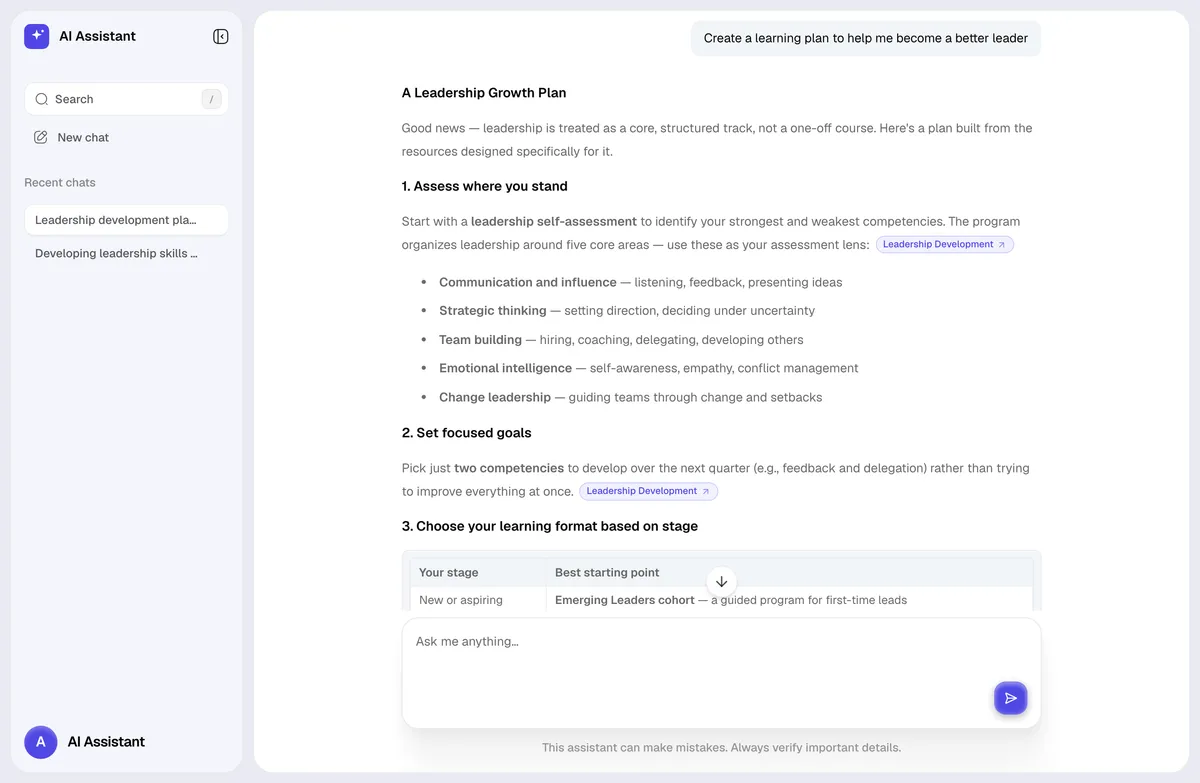
An AI assistant built on your body of knowledge
For associations, societies and certification bodies. Members ask about credentials, membership, ethics or training; it answers from your own content, cites the source, and declines what it cannot verify. Built in your cloud, on your keys, and owned by you.
Latest writing
All articles →- RAG Evaluation: Measuring Retrieval and Generation Separately
How to evaluate a retrieval-augmented system so failures point at a cause: IR metrics for retrieval, the six question-context-answer relationships for generation, building test sets without manual annotation, and a symptom-to-fix diagnosis table.
- Evaluating and Testing Voice Agents Before Real Callers Do
Text eval methods do not transfer cleanly to voice. A layered testing framework: adaptive simulated callers, persona and acoustic coverage, what to score beyond word error rate, adversarial and escalation testing, and the loop from production failure back into the suite.
- Multilingual and Code-Switching Voice Agents
Supporting two languages is not the same as supporting callers who mix them mid-sentence. Utterance-level language identification commits to one language before the switch happens, which no tuning can fix, so mid-sentence switching needs frame-level identification or an end-to-end multilingual model. Then retune turn detection, synthesis and tool calling per language.
- Turn Detection and Interruption Handling in Voice Agents
Voice agents that cut callers off and voice agents that leave dead air have the same bug: deciding when a turn has ended. Treat turn detection and interruption handling as separate problems, layer semantic detection over acoustic VAD, filter backchannels rather than treating every sound as a barge-in, and set thresholds by what the caller was just asked.
- Monitoring LLM Quality in Production
Passing evals prove only that the feature worked on the cases you thought of. In production, run your validated judges on a stratified sample of live traffic, track the silent failures infrastructure monitoring misses (refusals, truncation, cache hit rate), and alert only on joint conditions with a named owner. Then feed every failure back into the eval set.